Custom Adaptive Clothing Manufacturer
For brands comparing adaptive clothing manufacturers, develop inclusive apparel around a clearly defined dressing routine. Review opening placement, closures and seated proportions through sample development.
Everyday clothing. Thoughtful access.
Magnetic Shirts
Traditional shirt styling with concealed magnetic closures for a considered dressing experience.
Explore product ↗Easy-Dressing Pants
Everyday trousers with openings and waist details selected around a defined dressing routine.
Explore product ↗Side-Zip Pants
Trousers with extended side openings to make access a deliberate part of the design.
Explore product ↗Wheelchair Pants
Seated-fit trousers developed around waist coverage, leg position and accessible storage.
Explore product ↗Seated Jackets
Outer layers proportioned for a seated posture and comfortable access to front fastenings.
Explore product ↗Hook-and-Loop Clothing
Accessible closure layouts using hook-and-loop fasteners where the dressing brief calls for them.
Explore product ↗Senior Easy-Dressing Clothing
Familiar everyday garments with easier access and thoughtful details for senior clothing programs.
Explore product ↗Function, fit and a clear specification.
For brands comparing adaptive clothing manufacturers, develop inclusive apparel around a clearly defined dressing routine. Review opening placement, closures and seated proportions through sample development.
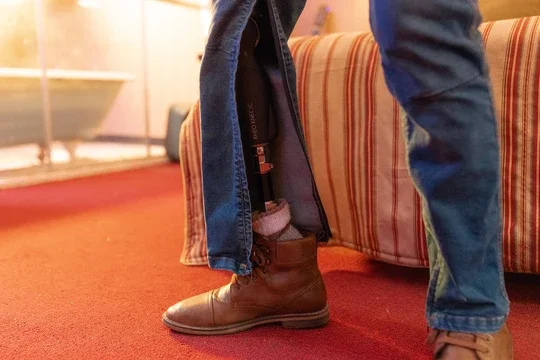
Adaptive clothing manufacturing for private-label brands
Develop adaptive clothing from a garment brief that defines dressing access, closure placement, fit, fabric, labels and the intended wearer or caregiver use. Production is in Humen, Dongguan, China. Sample review confirms the complete garment before bulk planning; this is apparel development, not a medical-device or treatment claim.
- Describe the dressing sequence first
- State how the garment is put on, taken off and adjusted, including any one-hand, seated or caregiver-assisted steps. Mark the required opening, closure type and location on a drawing or reference garment. A closure choice must be evaluated with the finished garment fit, not as an isolated feature.
- Separate access, fit and sensory details
- Access features may address dressing sequence or garment opening; sensory details may address fabric contact, labels or seam bulk. If your range needs both, list them separately in the brief. Provide the intended wearer group, measurements, range of motion and any areas where fabric or hardware placement needs special review.
- Approve the full garment on a sample
- Review the sample in the intended dressing sequence and fit position before confirming bulk production. Record changes to closure placement, garment length, fabric, label method or seam finish. Simple samples generally take 7–12 days and complex samples generally take 15–20 days; bulk timing is confirmed by style and quantity.
- Plan quantities by style and colour
- The MOQ is 100 pieces per style and colour, with a mix of 4 sizes. A top and trouser are separate styles, and the same garment in different colours needs separate minimum quantities. Send the proposed size allocation and destination with the quotation brief.
What to include in your enquiry
- Dressing sequence, intended wearer group and whether caregiver assistance is expected.
- Garment drawing or reference sample with access, closure and label locations marked.
- Measurement chart, fabric direction, fit position and construction details to review.
- Style/colour quantities of at least 100 pieces each, with a proposed mix of 4 sizes.
Start with the dressing need.
Adaptive apparel is everyday inclusive clothing. Product development does not imply a medical treatment effect or medical-device status.
Make the program your own.
Fabric & color
Specify composition, weight and a physical color reference. Review availability and approve the selected material.
Logo & labels
Review embroidery, print or transfer options on the chosen fabric. Provide care-label content and brand artwork.
Fit & packaging
Define the size range and measurements, then agree size allocation, labels, packaging and carton markings.
- Minimum order
- 100 pieces per style, per color, with a mix of 4 sizes
- Sample development
- 7–12 days for simple styles; 15–20 days for complex styles
- Bulk production
- Calculated according to style and order quantity
A clear manufacturing process.
Send Your Requirements
Share a tech pack, reference or product brief.
Design & Material Review
Align fit, construction and intended use.
Fabric & Trim Selection
Review material, color and closure options.
Sample Development
Make the agreed style for evaluation.
Approval
Confirm fit, details, labeling and packing.
Bulk Production
Produce against the approved specification.
Built for your sector.
Adaptive Clothing: project essentials
How do we start a adaptive clothing project?
For brands comparing adaptive clothing manufacturers, develop inclusive apparel around a clearly defined dressing routine. Review opening placement, closures and seated proportions through sample development.
Which materials can we review?
Soft cotton blends, Stretch woven fabrics, Low-bulk jersey. Final selection depends on your intended use and sample approval.
What should I send to adaptive clothing manufacturers for a first review?
Send a garment drawing or reference, intended dressing sequence, closure locations, fit and measurement requirements, fabric direction, label details, artwork, packing instructions and quantity by style and colour. Review the full garment on a sample before bulk approval.
Can adaptive clothing be developed as a private-label range?
Yes. Your brand artwork, labels, packaging and garment specification can be reviewed together during sample development. MOQ is 100 pieces per style and colour with a mix of 4 sizes. Production is in Humen, Dongguan, China; shipment and destination requirements are confirmed for each project.
Are adaptive clothing and sensory-friendly clothing the same?
They can overlap, but they solve different brief requirements. Adaptive clothing may address dressing access or fit; sensory-friendly development may address fabric contact, labels and seam details. Specify each requirement separately when a range needs both.
What is your MOQ?
Our minimum order is 100 pieces per style, per color, with a mix of 4 sizes. Each style/color combination must meet the minimum separately. For example, one style in two colors requires at least 200 pieces in total: 100 of each color. Share your allocation across the 4 sizes for review.
Can you develop samples?
Yes. Sample cost is from us$44.70 per sample; final price depends on materials and construction. Sampling takes 7–12 days for simple styles; 15–20 days for complex styles.
Do you provide OEM and ODM?
OEM starts with your design or tech pack. ODM includes assistance with concepts, patterns, materials and sample development.
Start a custom apparel conversation.
Have a tech pack, reference image or product idea? Send the essentials and we will help you plan material, construction and sampling options.