Custom Sensory-Friendly Clothing Manufacturer
Private label sensory-friendly clothing for children and adults. Develop soft everyday garments with considered labels, seams and fit through sample review. MOQ: 100 pieces per style, per colour, with a mix of 4 sizes.
Comfort starts with the smallest details.
Tagless T-Shirts
Private label tagless T-shirts for children's and adult ranges. Develop the neck-label solution, soft jersey and seam finish together, using separate fit measurements and wearer feedback.
Explore product ↗Seamless & Low-Seam Tops
Comfort-focused tops developed with reduced seam contact as the primary design objective.
Explore product ↗Soft Clothing
Custom soft clothing for children and adults, developed around fabric feel, neckline, waistband and seam preferences. Compare material options and review finished samples before confirming your private label range.
Explore product ↗Adaptive Basics
Simple everyday layers combining easy dressing with sensory-conscious details.
Explore product ↗Function, fit and a clear specification.
Private label sensory-friendly clothing for children and adults. Develop soft everyday garments with considered labels, seams and fit through sample review. MOQ: 100 pieces per style, per colour, with a mix of 4 sizes.
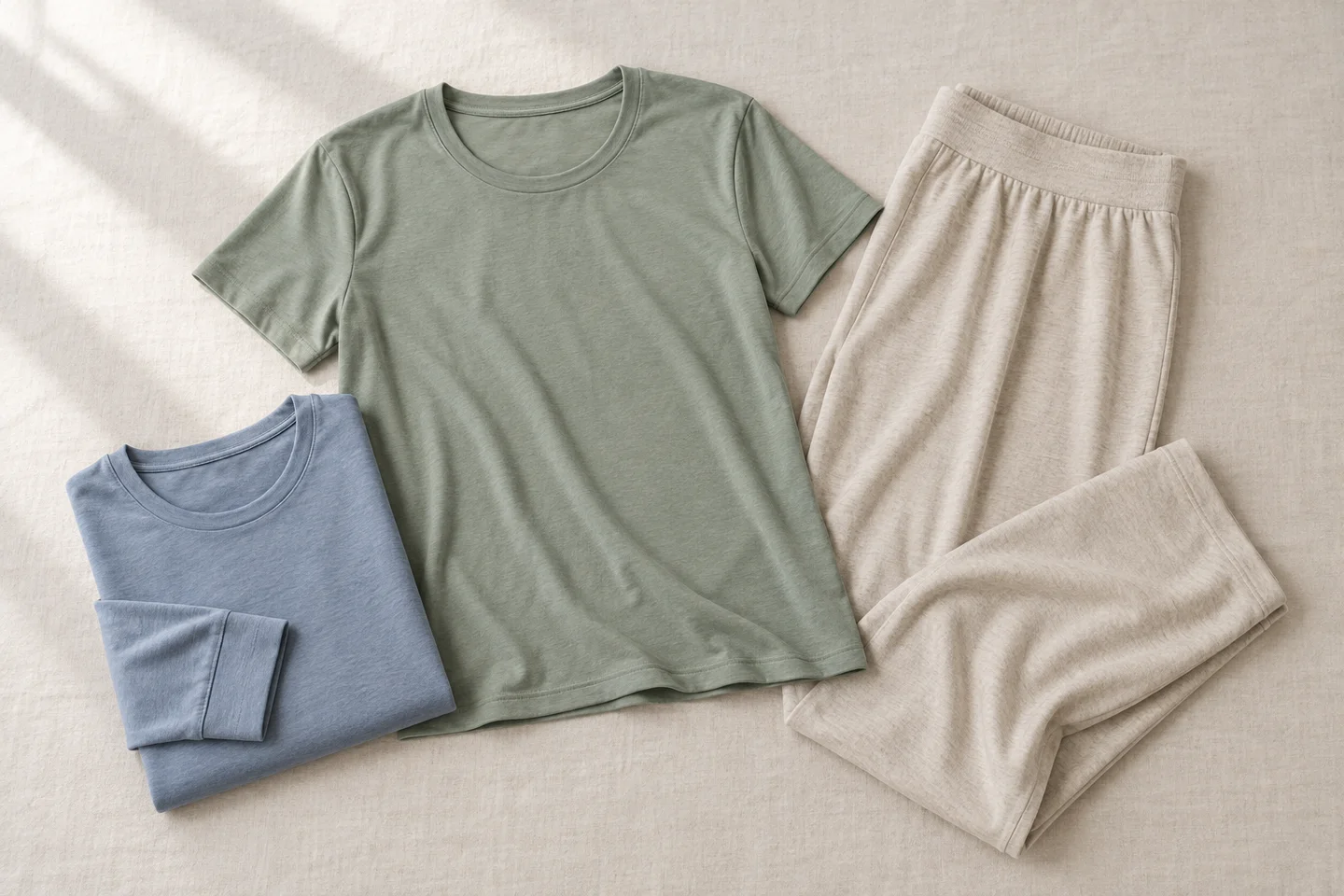
Private label sensory-friendly clothing for children and adults
Develop everyday clothing for children's and adult ranges around a specific wearer brief. Our factory reviews fabric feel, fit, labels, seams and trims during sample development. The starting point is what the intended wearers prefer and what your brand needs to reproduce, rather than a single definition of comfort for everyone.
- Develop children's and adult fits separately
- State whether the range is for children, adults or both. Provide separate measurements and reference garments for each fit block. A children's top should not simply be enlarged to create an adult pattern. Define neck opening, sleeve shape, body length and preferred ease for each proposed style.
- Compare fabric in the finished garment
- Combed cotton jersey, cotton–modal blends and soft stretch knits are options to review. Describe the preferred surface, weight and stretch, and send a fabric reference if available. Evaluate the sample before and after the intended wash routine; a soft swatch alone does not settle garment comfort or dimensional stability.
- Specify where the garment touches the skin
- Identify sensitive contact areas in the brief: neckline, shoulder, side seam, waistband or cuffs. Review label placement, seam bulk and any hardware at those locations. Tagless construction removes a sewn-in label at an agreed position; it does not automatically mean the garment has no seams or no required product information.
- Approve with wearer feedback
- Use sample review to record preferences about fit, fabric and finishing. Separate comments by wearer group and by garment detail so revisions can be acted on. Sensory preferences differ, and these garments are not offered as a treatment or with a promise of universal comfort.
What to include in your enquiry
- Children's or adult target range, with separate measurements and reference garments.
- Preferred and unwanted textures; neckline, waistband and seam-contact priorities.
- Label artwork and placement, trims to avoid, care expectations and packaging.
- Style/colour quantities of at least 100 pieces each, with the proposed mix of 4 sizes.
Make the program your own.
Fabric & color
Specify composition, weight and a physical color reference. Review availability and approve the selected material.
Logo & labels
Review embroidery, print or transfer options on the chosen fabric. Provide care-label content and brand artwork.
Fit & packaging
Define the size range and measurements, then agree size allocation, labels, packaging and carton markings.
- Minimum order
- 100 pieces per style, per color, with a mix of 4 sizes
- Sample development
- 7–12 days for simple styles; 15–20 days for complex styles
- Bulk production
- Calculated according to style and order quantity
A clear manufacturing process.
Send Your Requirements
Share a tech pack, reference or product brief.
Design & Material Review
Align fit, construction and intended use.
Fabric & Trim Selection
Review material, color and closure options.
Sample Development
Make the agreed style for evaluation.
Approval
Confirm fit, details, labeling and packing.
Bulk Production
Produce against the approved specification.
Sensory-Friendly Clothing: project essentials
How do we start a sensory-friendly clothing project?
Private label sensory-friendly clothing for children and adults. Develop soft everyday garments with considered labels, seams and fit through sample review. MOQ: 100 pieces per style, per colour, with a mix of 4 sizes.
Which materials can we review?
Combed cotton jersey, Cotton–modal blends, Soft stretch knits. Final selection depends on your intended use and sample approval.
Can you develop both children's and adult sensory-friendly clothing?
Yes. We review both children's and adult ranges. Specify the intended ages and separate fit measurements, material preferences and construction requirements. Each style and colour has a minimum of 100 pieces with a mix of 4 sizes; a combined range does not remove the minimum for each style/colour.
Are tagless, low-seam and seamless garments the same?
No. Tagless describes the absence of a sewn-in label at a specified location. Low-seam or flat-seam options concern seam placement, bulk or finishing. Fully seamless construction is a different manufacturing requirement and must be reviewed separately; it is not implied by a sensory-friendly brief.
Can we test fabric and label choices before bulk production?
Specify the alternatives you want reviewed during sample development. Approve the selected fabric, label application and construction on a garment sample, including the intended care routine and wearer feedback. Sample fees and any special techniques are quoted according to the brief.
What is your MOQ?
Our minimum order is 100 pieces per style, per color, with a mix of 4 sizes. Each style/color combination must meet the minimum separately. For example, one style in two colors requires at least 200 pieces in total: 100 of each color. Share your allocation across the 4 sizes for review.
Can you develop samples?
Yes. Sample cost is from us$44.70 per sample; final price depends on materials and construction. Sampling takes 7–12 days for simple styles; 15–20 days for complex styles.
Do you provide OEM and ODM?
OEM starts with your design or tech pack. ODM includes assistance with concepts, patterns, materials and sample development.
Have a Uniform or Adaptive Apparel Project?
Send us your reference images, tech pack, measurements or product concept. Our team can evaluate materials, construction and sampling options.